Responsive Timeline Slider
Your Event Title
Lorem ipsum dolor site amet, consectetur adipscing elit, sed do eisumod tempor incididut ut labore et dolore magna aliqua. Ut enim ad mimim venjam, quis nostrud exercitation ullamco laboris nisi ut aliquip ex ea commodo consequat.
Your Event Title
Lorem ipsum dolor site amet, consectetur adipscing elit, sed do eisumod tempor incididut ut labore et dolore magna aliqua. Ut enim ad mimim venjam, quis nostrud exercitation ullamco laboris nisi ut aliquip ex ea commodo consequat.
Your Event Title
Lorem ipsum dolor site amet, consectetur adipscing elit, sed do eisumod tempor incididut ut labore et dolore magna aliqua. Ut enim ad mimim venjam, quis nostrud exercitation ullamco laboris nisi ut aliquip ex ea commodo consequat.
Your Event Title
Lorem ipsum dolor site amet, consectetur adipscing elit, sed do eisumod tempor incididut ut labore et dolore magna aliqua. Ut enim ad mimim venjam, quis nostrud exercitation ullamco laboris nisi ut aliquip ex ea commodo consequat.
Your Event Title
Lorem ipsum dolor site amet, consectetur adipscing elit, sed do eisumod tempor incididut ut labore et dolore magna aliqua. Ut enim ad mimim venjam, quis nostrud exercitation ullamco laboris nisi ut aliquip ex ea commodo consequat.
50 TIMES WE’VE DARED TO EXPLORE
For the YUAA’s first return to IREC, (having taken a gap year in 2015), the team managed to create a Sky Metagenomics payload to test the biodiversity of the earth’s atmosphere. The team earned a coveted 2nd Place in the SDL Payload Challenge (out of more than 50 international teams!). This program encompassed YUAA’s first foray into Biology and Genetics, yielding an incredible win in return.
The Radio Astronomy team created a fully steerable radio satellite dish with signal-processing hardware and software. Along the way, project members were taught the basics of astronomy, signal processing, and data processing. To spread this knowledge, we held demonstrations of the dish functionality at high schools in and around the New Haven area. This project, along with CubeSat, was mentioned at the 2015 White House Astronomy Night.
The Rocket Competition team built Chronos, a rocket designed to fly 10,000 feet while carrying an atomic clock that attempted to measure relativistic effects during the 2014 Intercollegiate Rocket Engineering Competition (IREC) hosted by ESRA. The team was awarded 2nd in the SDL Payload Competition (out of 36 teams) and additional recognition from the judges for the experimental subject.
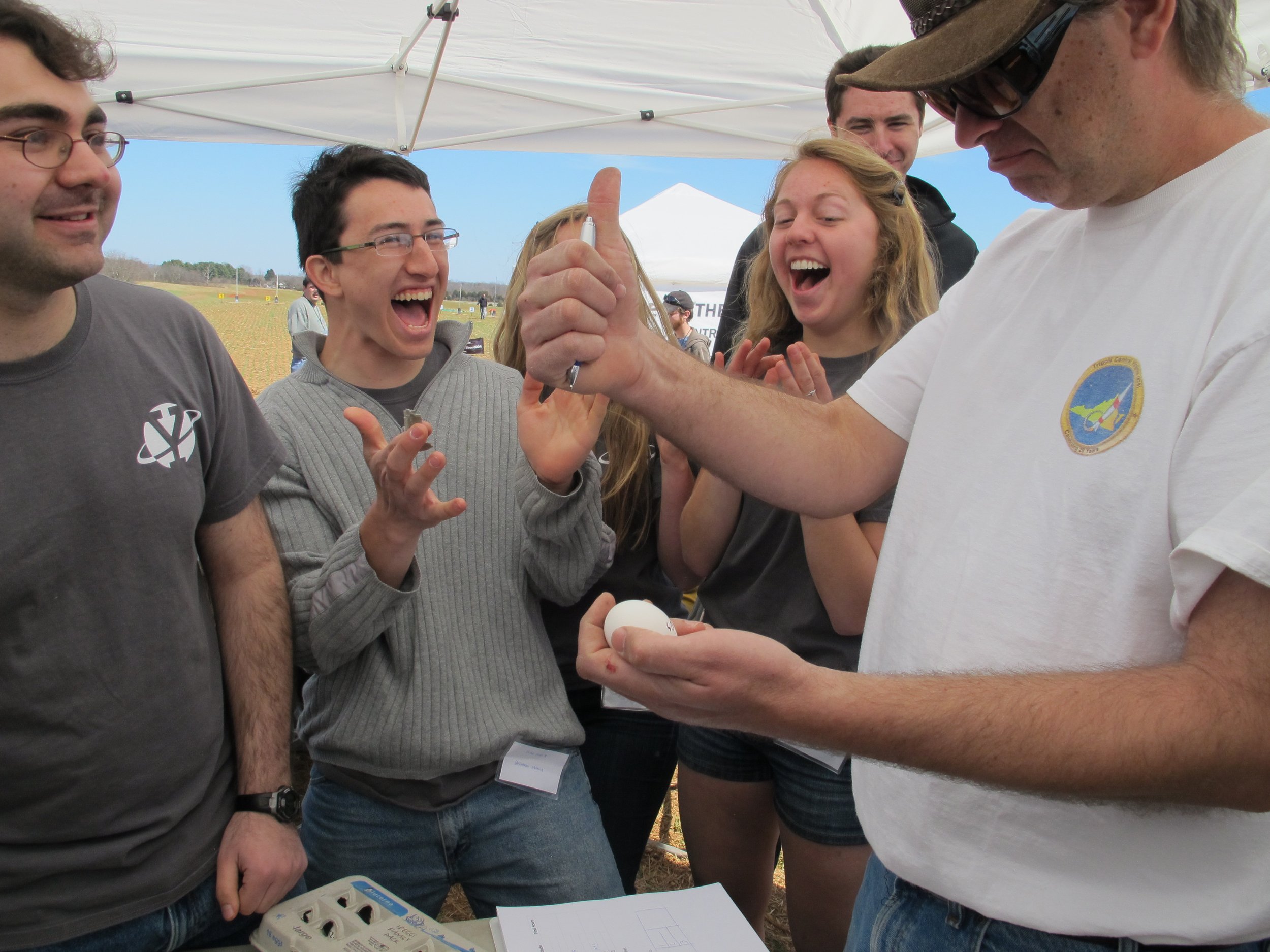
On April 6, 2013, YUAA won the Astro-Egg Lander event of the Battle of the Rockets Competition in Culpeper, Virginia. The team designed and built a rocket and lander capable of launching an egg up 1,500 feet and recovering it safely without a parachute. The team’s rocket, the YSS Eli Whitney, flew six times, including both test and competition launches.
On April 26, 2011, YUAA successfully launched and retrieved the YUAA Horizon, a second-generation high-altitude vehicle built by the YUAA. Horizon remains one of the most advanced amateur balloons to date, featuring two independent tracking systems, a failsafe aborting mechanism, a camera, and sophisticated software applications for real-time tracking on the ground.
2010-2011
On April 26, 2011, YUAA successfully launched and retrieved the YUAA Horizon, a second-generation high-altitude vehicle built by the YUAA. Horizon remains one of the most advanced amateur balloons to date, featuring two independent tracking systems, a failsafe aborting mechanism, a camera, and sophisticated software applications for real-time tracking on the ground.
Project Babelon, named as a cross between the Tower of Babel and Balloons, was the first project of the Yale Undergraduate Aerospace Association (YUAA), was then known as the Yale Air & Space Group (ASG).
2011-2012
SkyView improved on Explorer by optimizing high-altitude flight, tracking, and image capture. Launched in Spring 2012, an unfortunate gust of wind caused SkyView to land 4.3 miles off the coast of Connecticut, causing high-resolution images and the vehicle to be non-recoverable. Its estimated altitude was 11,200 meters.
Explorer was a high-altitude aircraft designed for atmospheric exploration and research. It featured an unparalleled array of tools and capabilities compared to former YUAA balloons and launched in January 2012.
2012-2013
The Quadcopter team built a four-rotor helicopter, or quadcopter, using a variety of sensors to ensure stable flight. The craft carried a high-definition camera on board to capture footage from angles otherwise impossible to reach.
The Command Center was designed to fulfill the electronics needs of any future craft developed by the organization. The main goal was to create a modular package capable of redundant communications methods, computational processing, location tracking, motor control, and sensor data logging.
On April 6, 2013, YUAA won the Astro-Egg Lander event of the Battle of the Rockets Competition in Culpeper, Virginia. The team designed and built a rocket and lander capable of launching an egg up 1,500 feet and recovering it safely without a parachute. The team’s rocket, the YSS Eli Whitney, flew six times, including both test and competition launches.
During the Spring of 2013, YUAA team members to launch a rocket to an altitude of 1,700 ft in preparation for the Battle of the Rockets Competition in Culpeper, Virginia. Our team used the Contrail G100 hybrid rocket motor, fulfilling the requirement for participants to use a commercially available rocket motor